Government as a means of security
Common SenseGovernment as a means of security is the standard Thomas Paine uses to explain why political authority is needed and to judge whether its form is legitimate. Society arises from human needs and mutual assistance; government becomes necessary when virtue proves insufficient to preserve justice. Its authority is therefore conditional: it exists to secure the people, not to rule for its own sake.
Society and the Need for Government
Paine distinguishes society from government by their origins and effects. Society is produced by human wants and unites affections through mutual intercourse; government answers to human wickedness by restraining vice, imposing distinctions, and punishing misconduct. Society is a blessing in every condition, whereas even the best government is a necessary evil, and the worst is intolerable.
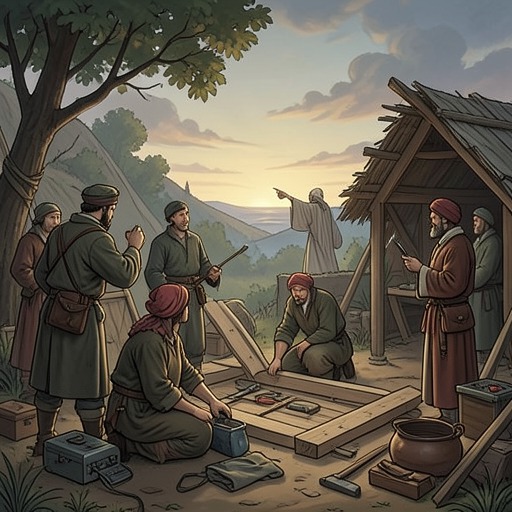
The need for government appears in Paine’s imagined settlement of a small group in an isolated part of the earth. In natural liberty, people would first form society because a single person could not readily meet ordinary needs alone. Four or five working together could build a tolerable dwelling in a wilderness, while one person might labor for much of a lifetime without finishing the work: after felling timber, he could neither move it nor raise it, and hunger and other needs would continually draw him away. Illness or misfortune could leave an isolated person unable to live, even if the immediate cause was not itself fatal.
Mutual need would initially bind the settlers together strongly enough that reciprocal benefits could make law and government unnecessary, provided they remained just to one another. But success in overcoming the first hardships of settlement would weaken their shared attachment and sense of duty. Government enters at that point to supply what diminishing moral virtue no longer reliably provides.
Security as the Measure of Authority
Paine’s account treats government as an instrument, not an end in itself. People surrender part of their property to provide protection for what remains; they do so prudently, choosing the lesser of two evils. Government resembles clothing as a badge of lost innocence: it testifies to the need to restrain conduct that conscience alone cannot keep in order. The image of kings’ palaces built on the ruins of paradise sharpens the contrast between uncorrupted human life and political arrangements made necessary by vice.
From this account Paine draws a direct test of political form: whichever arrangement is most likely to secure the people at the least expense and greatest benefit is preferable. He identifies freedom and security as government’s design and end. A government that fails to protect people, or exposes them to miseries they might face without government, compounds their suffering because they themselves furnish the means by which it is inflicted.
The standard thus limits political obligation. Authority is warranted by the protection it supplies, not by ceremony, inherited status, or the mere fact of its existence. Paine’s contrast between the directness of simple government and the confusing complexity of the English constitution reinforces the practical importance of this test: people must be able to identify where harmful power lies and what remedy is available.
Representation and Public Accountability
Paine’s imagined settlement also shows how institutions can serve the security principle. At first, the whole colony can meet beneath a convenient tree to deliberate on public matters. Its earliest laws may be no more than regulations, enforced by public disesteem, and every person has a natural right to a seat in this first assembly.
As the colony grows, distance and expanding public business make it impractical for everyone to gather on every occasion. The settlers therefore consent to leave legislative work to selected representatives, who are expected to share the concerns of those who appoint them and act as the whole community would if present. Dividing the colony into convenient parts allows each part to send its proper number of representatives, so that local interests receive attention.
Frequent elections are the safeguard against representatives developing interests separate from those of their electors. Returning after a few months to mix again with the wider community gives elected members a practical reason to remain faithful to the public. Paine locates the strength of government and the governed people’s happiness in this common interest and reciprocal support, rather than in the name of a king.
Resistance and the Failure of Protection
Paine applies the same principle to the conflict with Britain. He argues that repeated petitions had been rejected and that quiet efforts to secure peace had proved ineffectual. In his account, the use of arms becomes defensible not to enforce compliance with a pecuniary law, but in response to violence against people, destruction of property by armed force, and invasion by fire and sword. Once such defense became necessary, he holds, subjection to Britain should have ended and American independence should have been understood as dating from the first shot fired against the continent.
The account connects this argument to the first major outbreak of hostilities. Paine says he had been a strong supporter of reconciliation before April 19, 1775, but that news of that day’s events ended his willingness to accept the relationship. He also warns that delay and timidity, rather than Britain or Europe alone, could defeat America’s cause. These claims make protection the hinge between governmental purpose and resistance: when political authority ceases to secure the people and instead threatens them, its claim to continued obedience fails.
Paine’s proposed political future remains tied to how independence is achieved. He describes three possible routes: the legal voice of the people in Congress, military power, or a mob. The first, he argues, would give the people the opportunity to form a constitution; the others risk leaving the political outcome to force or disorder. Government as a means of security therefore governs both the case for separation and the responsibility to build an accountable order afterward.